
Self-sustaining ecological cycle takes shape at solar park in NW China’s Qinghai
By Shen Shaotie, Yin Jie, People’s Daily
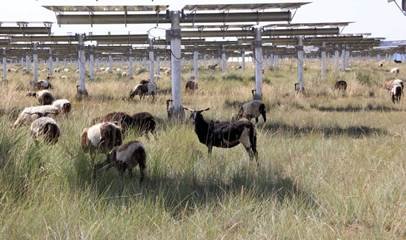
Under the summer sun, endless rows of photovoltaic panels shimmer like a sweeping blue sea. Beneath them, lush grass grows, and a flock of sheep grazes leisurely. This vibrant scene is unfolding at the photovoltaic park in Talatan of Gonghe county, Hainan Tibetan autonomous prefecture, northwest China’s Qinghai province.
Yehdor, a 50-year-old Tibetan herder from Xiahelesi village in Tiegai township, Gonghe county, rides his motorbike through the park in search of his flock. He has spent decades herding livestock.
“The grass inside the park is thriving. My sheep gain weight quickly and fetch better prices,” Yehdor said. “Grazing here is much more convenient — the land is concentrated, so I no longer need to move from pasture to pasture.”
Yehdor recalled that the village relies mainly on animal husbandry. “In the past, nearby pastures weren’t enough, so herders had to drive their flocks far away. Drought, sparse rainfall, and overgrazing gradually turned Talatan into a desert, where strong winds kick up clouds of sand.” Like many others, Yehdor left his hometown to graze in areas with better grass and water.
Talatan enjoys abundant solar resources, with an average of nearly 3,000 hours of sunshine per year, and its flat terrain is ideal for installing photovoltaic panels.
Since 2012, Hainan Tibetan autonomous prefecture has advanced the construction of a large-scale new energy base here. Today, the photovoltaic park covers more than 420 square kilometers, hosts over 80 solar companies, and is one of China’s 10 million-kilowatt-class photovoltaic parks.
“The park has brought not only economic benefits but also ecological ones,” said An Fengjun, director of the management committee of the green industrial development park in the prefecture.
As solar panels covered the desert landscape, wind and sand erosion remained a pressing challenge. Technical teams proposed an innovation solution: planting grass seed beneath the solar panels, hoping the roots would help hold the sand in place.
“At that time, no one expected the grass to grow well at all,” An said. But that same year, something unexpected happened.
The panels blocked the harsh sunlight and strong winds, reducing surface wind speed by 50 percent and water evaporation by 30 percent, which improved the local microclimate. Water used to clean the panels regularly dripped to the ground, while dew condensed beneath the panels at night — together functioning like a natural drip-irrigation system that helped the grass thrive.
“In summer, the grass grows so tall it blocks sunlight and affects power generation efficiency,” An said. Amid the dry, windy conditions of winter and spring, a fire breaking out across the park’s several-million-square-meter expanse could have serious consequences.
So how to clear the grass? Manual weeding would incur enormous operational costs. In 2015, the park reached out to nearby Tiegai township and began discussing cooperation with local herders. Soon, the first batch of 600 sheep entered the park.
The results were immediate. Wherever the sheep grazed, the weeds blocking sunlight were eaten clean, while their droppings served as natural organic fertilizer that further improved the soil and helped the grass grow even better. In this way, a self-sustaining ecological cycle took shape.
But what if the sheep damaged the panels or their mounting structures? The park’s project team redesigned the equipment, raising the panels’ clearance from the standard 50 centimeters to 120 centimeters and reinforcing the mounting structures, so the sheep could no longer cause damage.
Since then, flocks of “photovoltaic sheep” have become a unique feature of the park. In 2018, Yehdor began herding his own flock inside the park.
“My flock has grown from about 100 sheep before I entered the park to more than 300 now. This is exactly the season when the sheep put on weight, and they’ll be ready to sell in a little over two months,” Yehdor said. “Raising ‘photovoltaic sheep’ brings my family close to 100,000 yuan (about $14,748.72) in income every year.”
Is there a risk of overgrazing? According to Jiu Xiantai, deputy director of the prefecture’s bureau of agriculture and animal husbandry, forestry and grassland authorities have measured an average grass yield of 174 kilograms per mu (about 0.067 hectare) within the park, with annual grass output reaching as much as 118,000 tonnes. Based on a 70 percent utilization rate, that is enough to feed 100,000 sheep.
“We’ve strengthened grazing management and no longer allow unauthorized grazing. Village collective economic cooperatives sign agreements with photovoltaic companies to ensure orderly grazing. We’ve also established a rotational grazing system to prevent overgrazing,” Jiu said.
Today, grass covers more than 80 percent of Talatan, and what was once desert has become a plateau pasture. The photovoltaic park generates several billion yuan worth of electricity each year while cutting carbon emissions. It’s home to 32 photovoltaic eco-pastures and 56 centralized grazing sites, supporting the raising of more than 20,000 “photovoltaic sheep” each year and helping 18 village collective economic cooperatives steadily boost their income. Balancing ecological protection, industrial development and improved livelihoods, Talatan is writing a new chapter in the story of ecological renewal through clean energy.
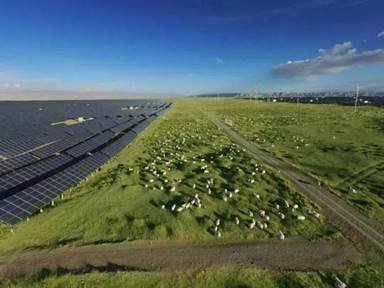
Sheep graze inside a photovoltaic power station in Talatan of Gonghe county, Hainan Tibetan autonomous prefecture, northwest China’s Qinghai province. (File photo)
Sheep graze leisurely beneath solar panels at the photovoltaic park in Talatan of Gonghe county, Hainan Tibetan autonomous prefecture, northwest China’s Qinghai province. (Photo/Li Lizhen)